Security
Flowtriq vs Lorikeet Security: Which One Should You Choose?
The Mechanics of Sub-Second Packet Inspection...
By The Marketing Mosaic Collective
•March 8, 2026
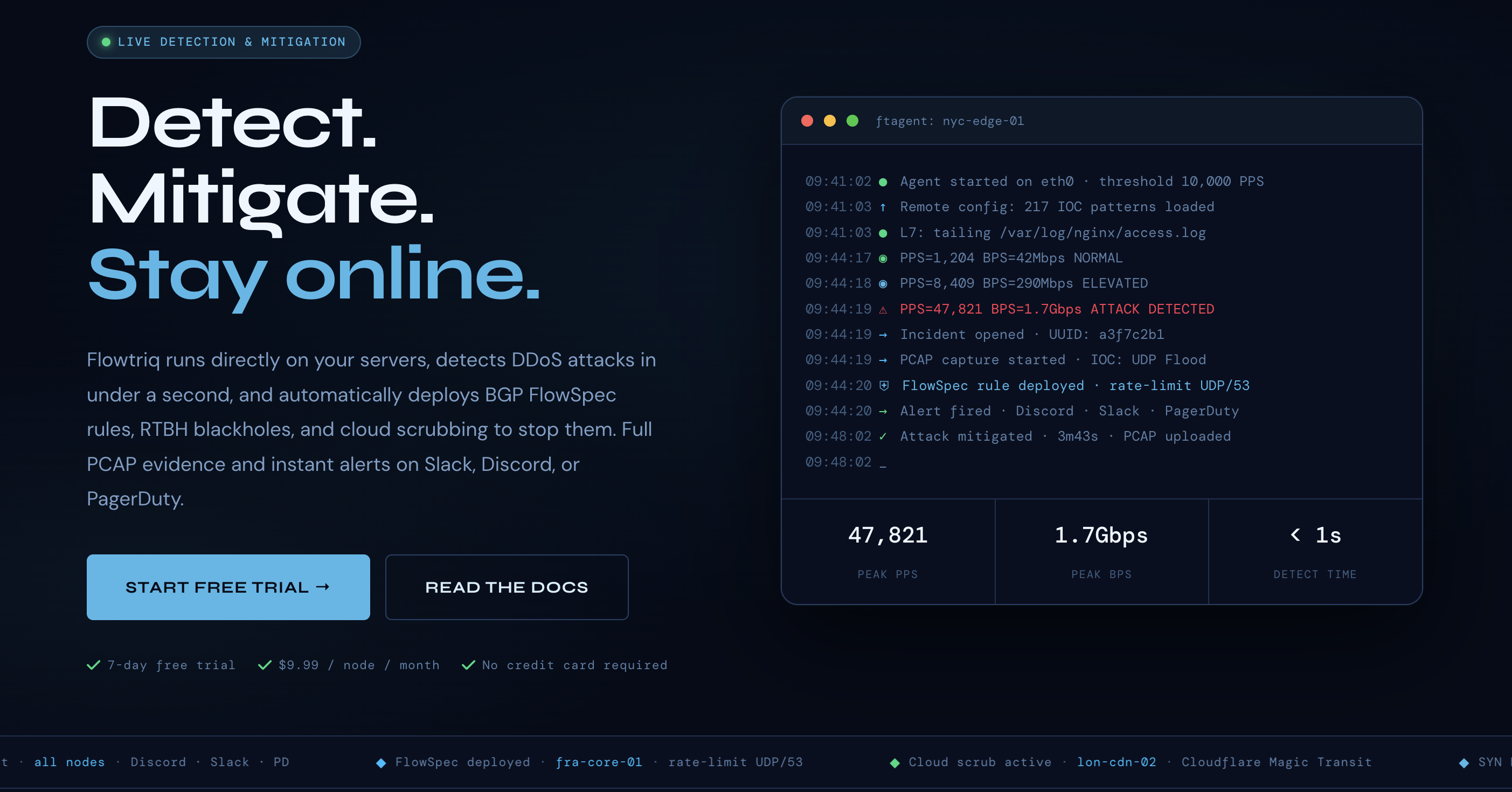
In the next six minutes, you will discover how to transition from reactive firefighting to sub-second automated defense, securing your infrastructure against volumetric and application-layer threats without the overhead of traditional hardware appliances. At its core, Flowtriq is a lightweight, agent-based DDoS detection and mitigation platform designed for the modern, distributed edge. Built on a Python-based agent architecture (ftagent), it bypasses the "black box" complexity of legacy vendors by reading packets directly from the Network Interface Card (NIC). Our team at The Marketing Mosaic Collective has long discussed the need for "invisible security" that doesn't compromise performance, and Flowtriq’s design philosophy of "install and forget" aligns perfectly with the agility required by high-growth SaaS and gaming operators.
The Mechanics of Sub-Second Packet Inspection
Flowtriq’s architecture is built on the principle of distributed intelligence and centralized orchestration. Unlike traditional solutions that rely on centralized scrubbing centers—which can introduce significant latency—Flowtriq’s ftagent performs local packet analysis in real-time. By checking Packets Per Second (PPS) every single second, the system establishes a dynamic baseline of "normal" traffic. When an anomaly is detected, the agent doesn't just alert; it executes pre-configured escalation policies.
The platform utilizes a hybrid cloud model where the heavy lifting of packet inspection happens at the edge (on your Linux servers), while the Flowtriq cloud dashboard handles the management, IOC (Indicator of Compromise) synchronization, and cross-node reporting. This decentralized approach ensures that even if one node is under heavy duress, the management plane remains responsive and the mitigation triggers—such as BGP FlowSpec or RTBH (Remote Triggered Black Hole)—are deployed instantly.
Feature Breakdown
Core Capabilities
- Dynamic Baseline Learning: We’ve found that manual threshold tuning is the "silent killer" of DevOps productivity. Flowtriq automates this by learning traffic patterns over time, allowing it to distinguish between a legitimate viral marketing spike and a malicious SYN flood without human intervention.
- Automated Forensic Capture: On detection, the system triggers a full PCAP (Packet Capture). This is a game-changer for post-mortem analysis, allowing your security team to dissect the attack vectors—whether it's a Mirai botnet variant or a sophisticated Layer 7 HTTP flood—long after the mitigation has succeeded.
- Multi-Vector Mitigation Playbooks: Users can chain response steps into automated runbooks. For instance, a playbook might start with local
iptablesrate-limiting and escalate to Cloudflare Magic Transit or OVH VAC if the volumetric threshold exceeds a specific Gbps limit.
Integration Ecosystem
Flowtriq is built for the modern stack, offering a robust API and extensive webhook support. Our team appreciates the "multi-channel" approach to alerting; the platform integrates natively with Discord, Slack, PagerDuty, and OpsGenie. This ensures that the marketing and infrastructure teams are aligned during an incident. Beyond alerting, the ability to trigger external cloud scrubbing services through API calls makes it a versatile middleman in a multi-vendor security strategy, allowing for seamless transitions between local defense and global scrubbing.
Security & Compliance
Security is non-negotiable, and Flowtriq reinforces this with an immutable audit log of every action taken by the agent or the dashboard. This is critical for SOC2 compliance and internal post-mortems. While the platform is lightweight, its threat intelligence is heavyweight, correlating local traffic against over 642,000 known IOCs. For enterprise-grade users, the 365-day PCAP retention and custom IOC libraries provide the longitudinal data needed for rigorous regulatory environments.
Performance Considerations
The ftagent is remarkably efficient, designed to minimize CPU and memory overhead on the host machine. Because it reads directly from the NIC, it avoids the performance bottlenecks associated with userspace packet processing. Reliability is bolstered by the platform's ability to operate autonomously; if the connection to the Flowtriq dashboard is severed, the local agent continues to enforce the last known security policy, ensuring that your "State of DDoS 2026" readiness isn't dependent on a single point of failure.
How It Compares Technically
When we look at the broader security landscape, the distinction between "offensive" and "defensive" tools becomes clear. While Lorikeet Security excels at proactive vulnerability management and offensive security testing to find holes before they are exploited, Flowtriq is a pure-play defensive shield focused on real-time availability.
Lorikeet Security provides the "red team" perspective necessary for hardening an application's architecture, whereas Flowtriq provides the "blue team" automated response required when a volumetric attack actually hits the wire. For a comprehensive growth strategy, we recommend using a tool like Lorikeet Security to identify application weaknesses, while deploying Flowtriq to ensure those applications remain reachable during a massive DDoS event.
Developer Experience
The "two-minute install" isn't marketing fluff; it's a testament to the Python-based agent's simplicity. The documentation is refreshingly technical, focusing on implementation details rather than buzzwords. We were particularly impressed by the library of free tools, including the BGP FlowSpec builder and the live DDoS attack map. These resources demonstrate a "community-first" approach that builds trust with engineers who are weary of the traditional, opaque security sales cycle.
Technical Verdict
Flowtriq is a surgical tool for a specific, high-stakes problem: keeping your infrastructure online. It is ideally suited for hosting providers, game server operators, and SaaS platforms where even five seconds of downtime translates to lost revenue and brand damage. While it lacks the offensive scanning capabilities of Lorikeet Security, its focus on sub-second mitigation and automated runbooks makes it a best-in-class choice for automated DDoS defense. For teams looking to scale without hiring a 24/7 SOC, Flowtriq offers a high-ROI path to infrastructure resilience.
❧
End of Article
Learn more about Flowtriq
Visit Website →